
WATER SUPPLY & SEWER
Water is a precious resource. Use it wisely.
Water and Sewer in the Valley Springs Area
Most of the “town center” of Valley Springs gets its water from Valley Springs Public Utility District (VSPUD), whose water source is an underground well (groundwater). VSPUD also provides sewer service to the town area. Some commercial areas to the south are served by Calaveras County Water District (CCWD).
Most residents in the subdivisions of Rancho Calaveras, La Contenta, and Gold Creek get their water from Calaveras County Water District (CCWD). Their water source is New Hogan Reservoir (surface water/rainfall). Some residents in Rancho are not hooked up to district water and are on underground wells*. CCWD also provides sewer service to La Contenta and Gold Creek, but Rancho Calaveras lots are on individual septic systems.
Outside of these areas, most people are on private wells and septic tanks. Many wells have good quality reliable water; others range in quality and reliability of water supply. Some wells have failed; some have had to be deepened and/or had filtering and treatment systems installed.
*Read article ‘Subdivision Weighs Plan to Solve Water Woes’, D. Nichols 10-4-09
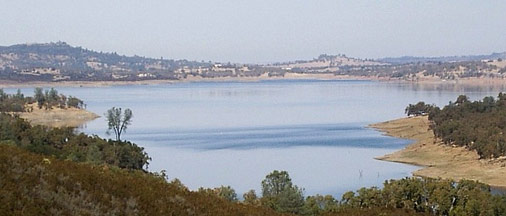
New Hogan Reservoir
During an average year, CCWD is entitled to approximately 31,000 acre-feet of water from New Hogan Reservoir for its customers. Actual water use averages around 4,000 acre-feet. Stockton East Water District (SEWD) uses all or part of the unused portion.
New Hogan Reservoir has a storage capacity of 317,000 acre-feet. This storage is supplied by the Calaveras River watershed and is rainfall-dependant. During the last major California drought from 1987-92, Hogan was filled to only 10.5% or less of its capacity for half of the six year drought period. In other words, for 36 months out of 72, New Hogan had anywhere from a low of 14,933 acre-feet to a high of 33,453 acre-feet. These amounts were shared between CCWD customers and SEWD customers for municipal, industrial, and agricultural uses.
15,000 acre-feet is the “minimum pool.” When water levels in the reservoir are too low, it’s called “Dead Pool storage.” Water quality becomes a problem, and treatment is more difficult (due to high concentrations of sediment and manganese).
Read an interesting summary ‘Letter on Hogan drought years’, L.W. 12-8-05
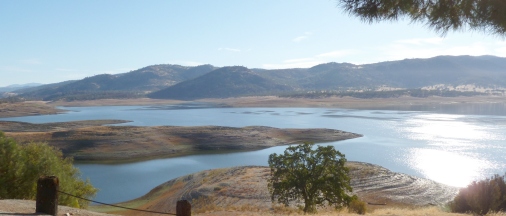
New Hogan Reservoir October 2014 at 42,431 AF
Mandatory Stage 3.5 Water Conservation
On May 13, 2015, due to Governor Brown's January 'State of Emergency' drought order and State Water Resources Control Board emergency water regulations May 5, the Calaveras County Water District adopted new watering restrictions, "Stage 3.5 Mandatory Water Conservation Measures." These restrictions apply to all 12,600 CCWD customers. CCWD is expected to achieve a collective reduction of 32 percent countywide. Click here for new watering restrictions, which include limiting outdoor irrigation to two days a week. On June 16, 2015, CCWD issued a Press Release that provides information regarding CCWD's mandatory water conservation standard being reduced from 32 percent to 16 percent by the State Water Resources Control Board.
Mandatory Stage III Water Conservation
In May 2014, due to continued drought, the California State Water Resources Control Board sent CCWD a "Notice of Unavailability of Water and Immediate Curtailment." CCWD was ordered to cease water rights diversions except for human health and safety. To ensure maximum conservation, on June 11, 2014, the CCWD Board of Directors adopted Mandatory Stage III Water Conservation Measures. These restrictions apply to all 12,600 CCWD customers countywide. The goal is to reduce water use in the entire district by 35%.
Watch CCTV "Calaveras Living" video about new Stage III restrictions, and learn water-saving tips
For further information, visit the CCWD website or call (209) 754-3543.
Voluntary Water Conservation, System Limitations
Water availability is affected by rainfall, storage capacity, usage, and delivery systems. When rainfall is below average for 3 years, the water supply in Hogan Reservoir can drop to under 20% of storage capacity. CCWD asks customers to use voluntary water conservation measures during the summer.
In addition to water supply and storage, “system design capacity” limits how much water can actually be delivered during periods of high demand. The existing pipes underground, the pumps for the water, the treatment plant, and the storage tanks all limit water availability.
Read 5/25/07 CCWD Water Conservation Press Release for more about water conservation and system limitations
Rancho Calaveras Water Outage July 2006
In April 2006, the Valley Springs area suffered extensive flooding due to heavy winter and spring rainstorms. New Hogan Reservoir was filled to its maximum water storage capacity. Despite this full reservoir, due to an extensive July heat wave, a weekend power outage, and limitations of existing infrastructure (pipes, pumps, filters, storage tanks), some Rancho Calaveras residents suffered water outages in July 2006. Water restrictions and conservation were necessary.
Read 7/24/06 CCWD Emergency Declaration regarding the water delivery problems, outage, and temporary restrictions on outdoor watering.
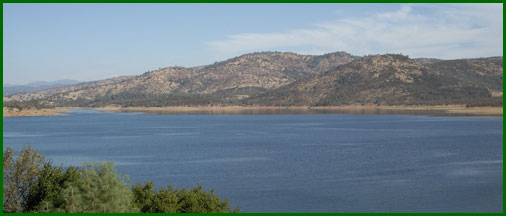
New Hogan Reservoir September 2006 (Rancho Calaveras water outage July 2006)
Sources for more information:
See our Research and Info Links page and Recommended Reading page
‘High and Dry: A History of the Calaveras River and its Hydrology’ by Leslie Crow, Historian (2006) In coordination with Stockton East Water District , 6767 E. Main St., Stockton, CA. 95215. (209) 948-0333. To see photos and read excerpts, visit: http://www.sewd.net/docs/record.pdf
Calaveras County Water District website for water studies & reports, conservation guidelines, meetings, plans/projects/facilities, etc.
Valley Springs Public Utility District website for meeting agendas and minutes, and information about history and facilities.


HOME
About Us
Support & Action
Planning
Current Development
What's Happening
Resources & Links
Contact Us